Kitano Group • Ecological Genetics Laboratory
Yamasaki, Y.Y., Yamaguchi, R., Nagano, A. J., Chen, B.J., Musto, N., Archambeault, S., Peichel, C.L., Schulien, J.A., Code, T.J., Beauchamp, D.A., and Kitano, J.
Inferring the strength of directional selection on armor plates in Lake Washington stickleback while accounting for migration and drift.
Evolution in press (2025) DOI:10.1093/evolut/qpaf254
Is evolution too slow to observe? Evolution is often thought of as a slow process unfolding over vast geological timescales. Researchers have shown that stickleback fish in Lake Washington (Seattle, USA) have undergone measurable evolutionary change between 2005 and 2022.
The study revealed that sticklebacks with complete bony plates had survival rates several percentage points higher than those with reduced plates, indicating ongoing natural selection. Moreover, the strength of selection appears to have intensified between 2016 and 2022. These findings demonstrate that natural selection can drive rapid evolution in natural populations. The paper was published in Evolution on 16 December 2025.
To rigorously demonstrate that these changes reflect natural selection rather than demographic processes, it is essential to quantify selection while accounting for migration from other populations and genetic drift. Although recent advances in molecular genetics have enabled researchers to identify genes underlying phenotypic traits and to estimate the strength of natural selection acting on them, estimating selection in natural populations remains challenging when migration from other populations occurs, as migration can obscure the effects of selection.
A research group led by Professor Jun Kitano and Assistant Professor Yo Yamasaki of the National Institute of Genetics, together with Assistant Professor Ryo Yamaguchi of Hokkaido University, and collaborators in the United States and Switzerland, integrated whole-genome sequencing data to estimate key population demographic parameters, including migration rates and effective population size. By incorporating these parameters into predictive models, the team was able to quantitatively estimate the strength of natural selection in a natural system. Their analyses further showed that selection pressure increased between 2016 and 2022.
Professor Jun Kitano commented:
“About 20 years ago, I found that sticklebacks in Lake Washington had evolved since the 1960s. When I revisited this lake population in 2022, I was surprised to see that evolution was still ongoing and that selection pressure had intensified. Because Lake Washington is connected to the sea and inflowing rivers, migration from surrounding populations makes it difficult to accurately estimate selection. We have now established a quantitative framework to overcome this challenge. By studying cases of rapid evolution in nature, we can directly observe how natural selection drives evolutionary change in real time.”
This research was supported by JSPS KAKENHI (22H04983, 20J01503, 21H02542, 22KK0105), JST CREST (JPMJCR20S2), and the King County WRIA8 Cooperative Watershed Management Grant Program.
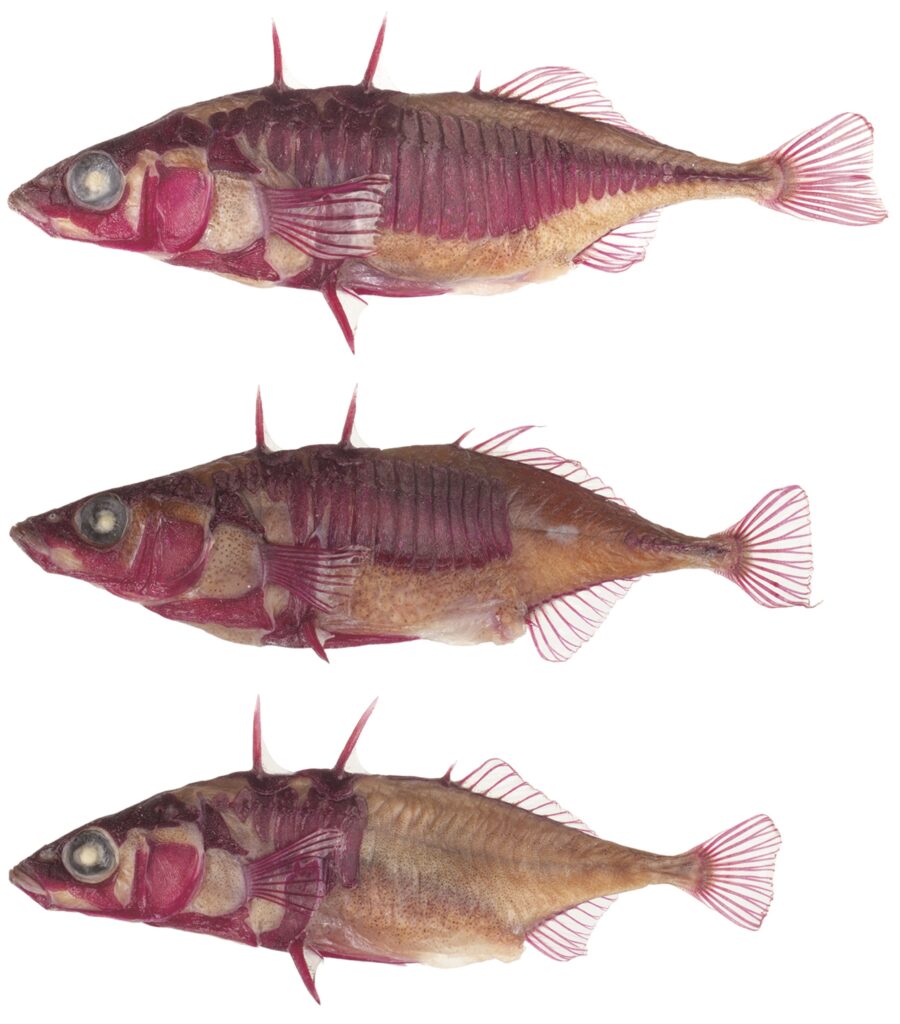
Figure: In Lake Washington, the frequency of stickleback fish with “complete” plates, characterized by bony lateral plates covering the entire flank of the body (top), has increased.