Sawa Group • Multicellular Organization Laboratory
Differential functions of multiple Wnts and receptors in cell polarity regulation in C. elegans
Hitoshi Sawa , Masayo Asakawa , Takefumi Negishi
Genetics(2026)DOI:10.1093/genetics/iyag004 DOI:10.1101/2025.11.25.690575
Metazoan species possess multiple Wnt ligands and receptor genes that regulate diverse developmental processes. Because these genes often act redundantly, analysis of single-gene mutants does not necessarily reveal the full roles of Wnt signaling. In C. elegans, three Wnt genes (cwn-1, egl-20, and cwn-2) and three receptor genes (lin-17/Fzd, mom-5/Fzd, and cam-1/Ror) redundantly regulate the polarity of asymmetrically dividing seam cells. Here, we comprehensively analyzed genetic interactions among these Wnt and receptor genes. In mom-5 mutant backgrounds, additional mutations in Wnt genes disrupted cell polarization. In contrast, in cam-1 mutant backgrounds, Wnt mutations frequently caused abnormal polarity orientation. These findings indicate that MOM-5 and CAM-1 play distinct roles in establishing cell polarization and determining its orientation, respectively. lin-17 mutations suppressed polarity reversal in multiple Wnt compound mutants, suggesting that LIN-17 may function as a molecular switch for polarity orientation. Although all three Wnt genes regulate polarity orientation in a gradient-independent manner in the absence of receptor mutations, in lin-17 mutant backgrounds, reversing the expression gradients of cwn-1 and egl-20, but not cwn-2, enhanced polarity reversal. This suggests that cwn-1 and egl-20 act not only permissively but also instructively to regulate polarity orientation. Together, our results reveal distinct and cooperative functions of multiple Wnt ligands and receptors that ensure robust control of cell polarity.
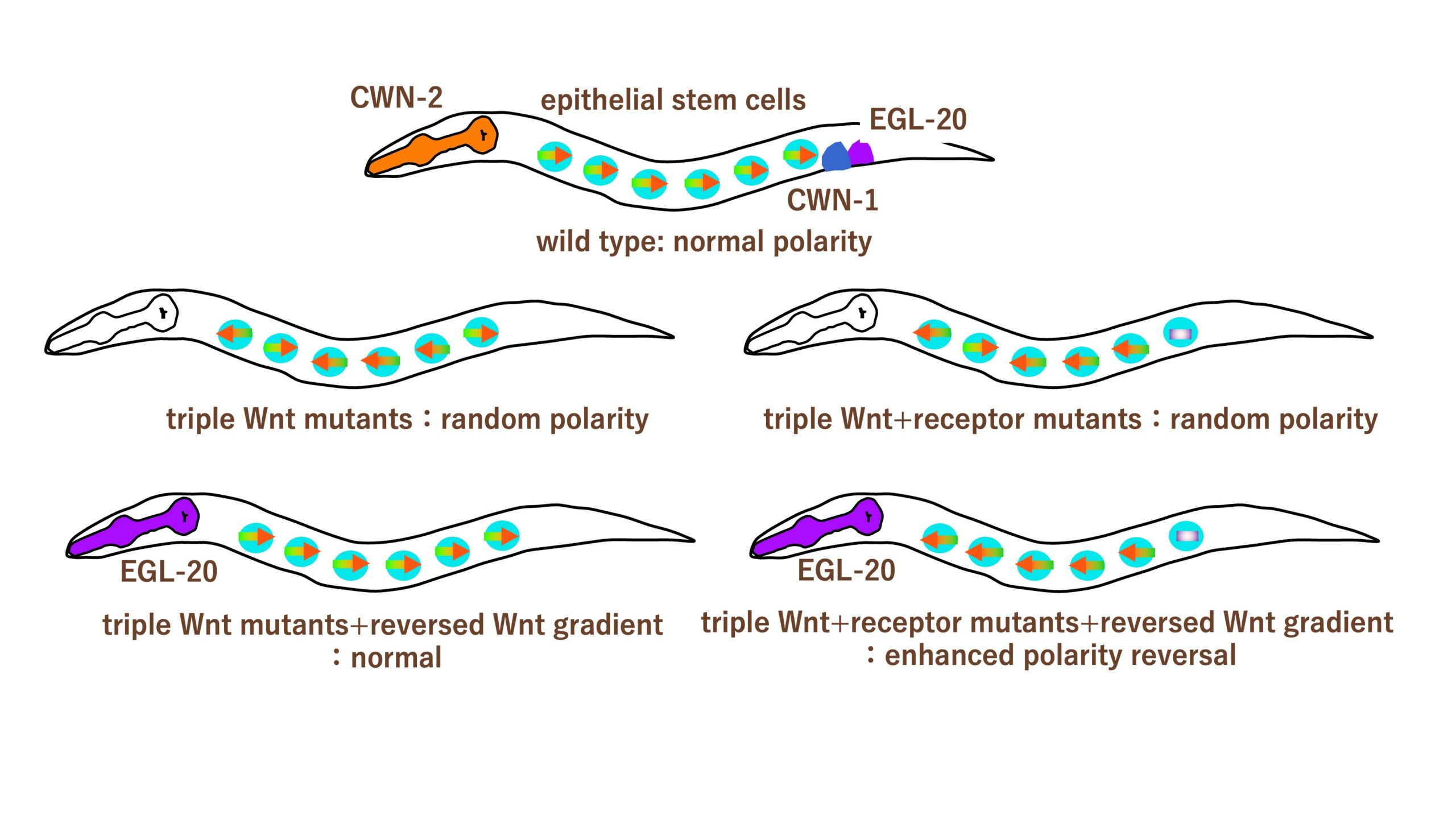
In triple Wnt mutants or triple Wnt+ receptor (lin-17/Frizzled) mutants, polarity of epithelial stem cells are randomized. When Wnt (EGL-20) which is normally expressed posteriorly, is expressed anteriorly reversing the Wnt gradient, polarity defects are rescued in triple Wnt mutants, while it enhances polarity reversal in triple Wnt+ receptor mutants.
Kitano Group • Ecological Genetics Laboratory
Yamasaki, Y.Y., Yamaguchi, R., Nagano, A. J., Chen, B.J., Musto, N., Archambeault, S., Peichel, C.L., Schulien, J.A., Code, T.J., Beauchamp, D.A., and Kitano, J.
Inferring the strength of directional selection on armor plates in Lake Washington stickleback while accounting for migration and drift.
Evolution in press (2025) DOI:10.1093/evolut/qpaf254
Is evolution too slow to observe? Evolution is often thought of as a slow process unfolding over vast geological timescales. Researchers have shown that stickleback fish in Lake Washington (Seattle, USA) have undergone measurable evolutionary change between 2005 and 2022.
The study revealed that sticklebacks with complete bony plates had survival rates several percentage points higher than those with reduced plates, indicating ongoing natural selection. Moreover, the strength of selection appears to have intensified between 2016 and 2022. These findings demonstrate that natural selection can drive rapid evolution in natural populations. The paper was published in Evolution on 16 December 2025.
To rigorously demonstrate that these changes reflect natural selection rather than demographic processes, it is essential to quantify selection while accounting for migration from other populations and genetic drift. Although recent advances in molecular genetics have enabled researchers to identify genes underlying phenotypic traits and to estimate the strength of natural selection acting on them, estimating selection in natural populations remains challenging when migration from other populations occurs, as migration can obscure the effects of selection.
A research group led by Professor Jun Kitano and Assistant Professor Yo Yamasaki of the National Institute of Genetics, together with Assistant Professor Ryo Yamaguchi of Hokkaido University, and collaborators in the United States and Switzerland, integrated whole-genome sequencing data to estimate key population demographic parameters, including migration rates and effective population size. By incorporating these parameters into predictive models, the team was able to quantitatively estimate the strength of natural selection in a natural system. Their analyses further showed that selection pressure increased between 2016 and 2022.
Professor Jun Kitano commented:
“About 20 years ago, I found that sticklebacks in Lake Washington had evolved since the 1960s. When I revisited this lake population in 2022, I was surprised to see that evolution was still ongoing and that selection pressure had intensified. Because Lake Washington is connected to the sea and inflowing rivers, migration from surrounding populations makes it difficult to accurately estimate selection. We have now established a quantitative framework to overcome this challenge. By studying cases of rapid evolution in nature, we can directly observe how natural selection drives evolutionary change in real time.”
This research was supported by JSPS KAKENHI (22H04983, 20J01503, 21H02542, 22KK0105), JST CREST (JPMJCR20S2), and the King County WRIA8 Cooperative Watershed Management Grant Program.
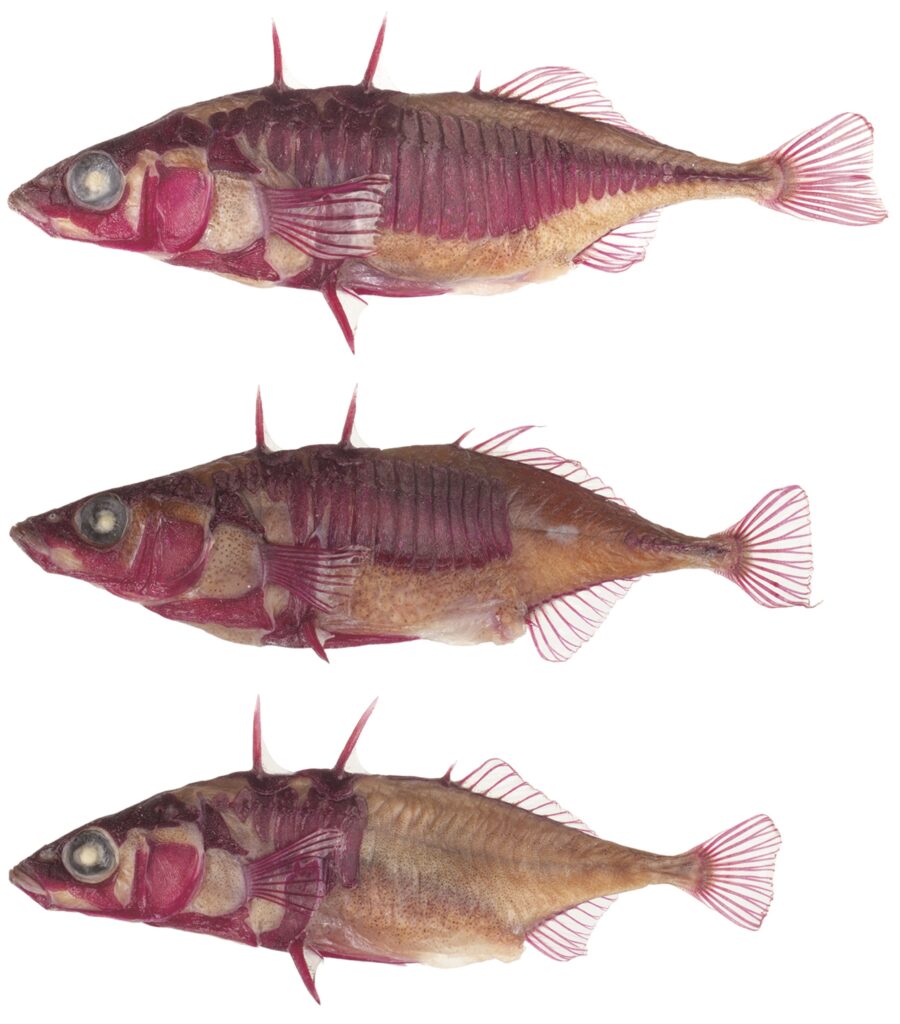
Figure: In Lake Washington, the frequency of stickleback fish with “complete” plates, characterized by bony lateral plates covering the entire flank of the body (top), has increased.
Miyagishima Group • Symbiosis and Cell Evolution Laboratory
IPTG- and estradiol-inducible gene expression systems in the unicellular red alga Cyanidioschyzon merolae.
Takayuki Fujiwara, Shunsuke Hirooka, Shota Yamashita, and Shin-ya Miyagishima.
Plant Physiology(2025) DOI:10.1093/plphys/kiaf575
The genetically tractable unicellular red alga Cyanidioschyzon merolae has a remarkably simple genome (4,775 nucleus-encoded proteins) and cellular architecture. It contains only a single set of most membranous organelles, making it a valuable tool for elucidating the fundamental mechanisms of photosynthetic eukaryotes. However, as in other genetically tractable eukaryotic algae, previously developed systems for inducible gene expression rely on environmental stimuli such as heat shock or ammonium depletion, which impact cellular physiology and thus limit their usage. To overcome this issue, we developed IPTG- and estradiol-inducible gene expression systems in C. merolae in which the addition of these chemicals itself has no impact on cellular growth or the transcriptome. Additionally, we established IPTG- and estradiol-inducible protein knockdown systems and successfully degraded the endogenous chloroplast division protein DRP5B using the estradiol-inducible system. These systems facilitate functional genomic analyses in C. merolae, especially for understanding physiological mechanisms and their interactions in photosynthetic eukaryotes.
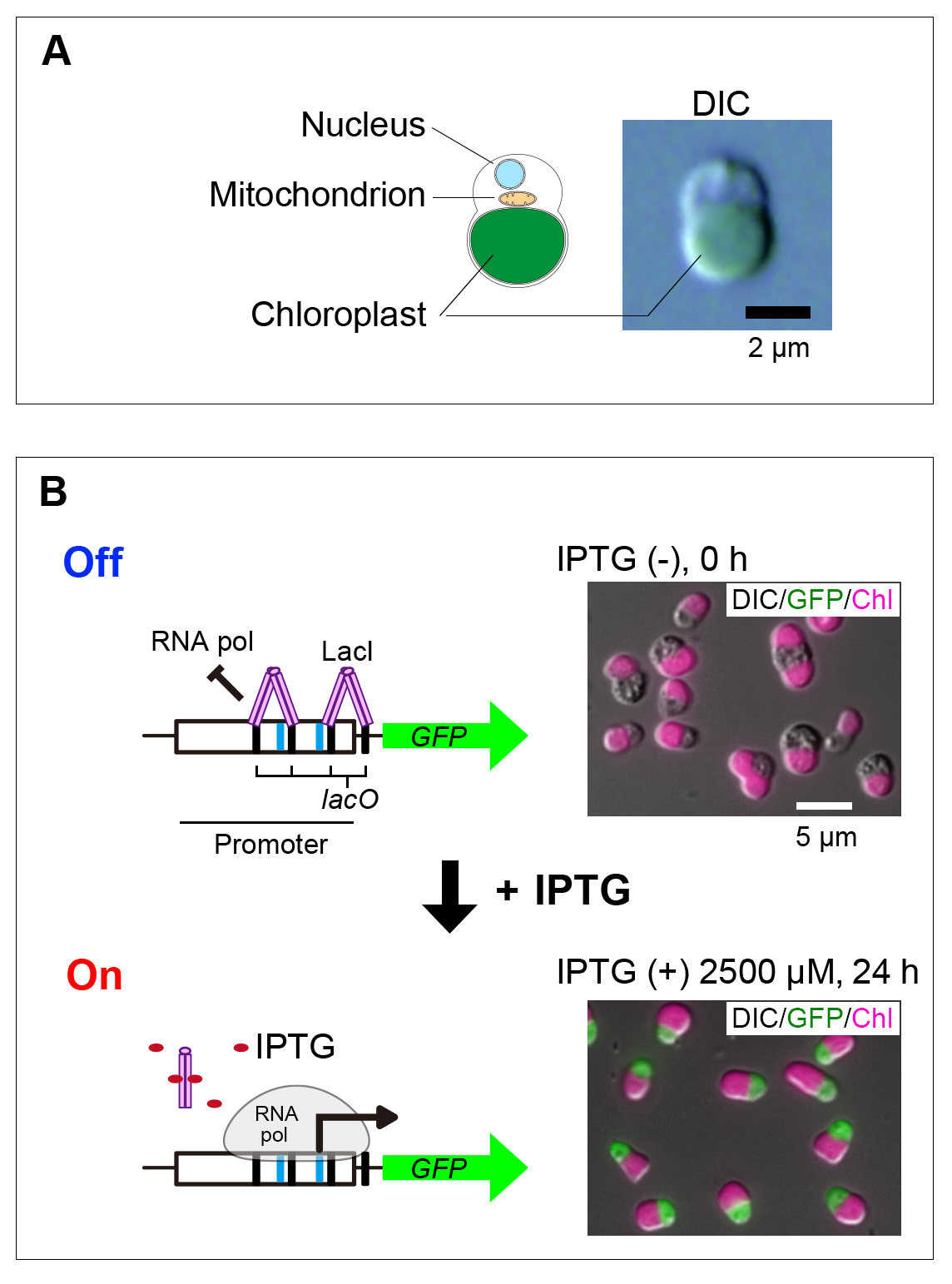
IPTG-inducible gene expression system.
(A) Schematic illustration of the cellular structure and differential interference contrast (DIC) image of Cyanidioschyzon merolae, a species of microalgae.
(B) Schematic overview of the IPTG-inducible gene expression system and fluorescence microscopy images of cells expressing the reporter protein GFP (green) in an IPTG-dependent manner. Four lac operator (lacO) sequences were inserted into the promoter region, and an Escherichia coli–derived LacI repressor was expressed separately to suppress transcription by binding to these sites. Upon addition of IPTG, LacI dissociates from the lacO sequences, allowing transcription to initiate. GFP protein expression was detected from 4 hours after IPTG addition. DIC images show cell outlines, GFP (green) indicates cytosolic fluorescence, and Chl (magenta) represents chloroplast autofluorescence. Scale bars are indicated in the images.
Kitano Group • Ecological Genetics Laboratory
The interplay of sexual selection and hybridisation can drive sexual radiation
Kotaro Kagawa
Proceedings of the Royal Society B (2025) DOI:/10.1098/rspb.2025.2605
Rapidly diverging lineages often involve interspecific variation in mating displays—such as nuptial coloration, mating songs, and courtship dances. Currently, the evolutionary processes underlying the formation of such groups that exhibit diverse mating displays remain largely unclear, especially when they lack clear ecological differences and significant hybrid incompatibility. Based on computer simulations of evolution, we propose that hybridisation between genetically distinct lineages can provide a route to rapid speciation accompanied by diversification of mating displays. A key process in this mechanism is an alteration of the sexual selection regime, caused by hybridisation increasing genetic variation in mate preference within populations.
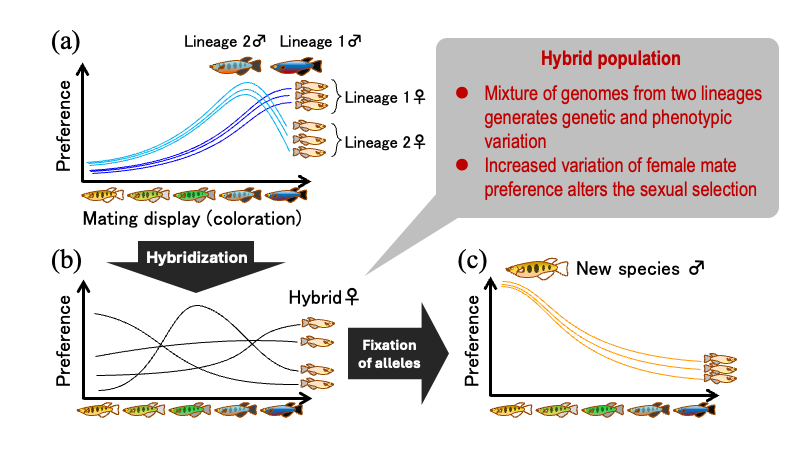
Schematic illustration of our hypothesis. The hypothesis considers hybridization between two genetically distinct lineages within an ancestral species (a). Hybridization generates interindividual variation in female mate preferences, thereby altering the sexual selection regime (b). This mechanism can promote the evolution of a new species with a novel mating display.