Press release
The histone chaperone CAF-1 prevents homologous recombination-mediated instability of the budding yeast ribosomal DNA during replication-coupled DNA double-strand break repair
Hajime Futami, Tsugumi Yamaji, Yuko Katayama, Nanase Arata, Mio Nagura, Takehiko Kobayashi, and Mariko Sasaki
Nucleic Acids Research(2025) DOI:10.1093/nar/gkaf1010
 Press release (In Japanese only)
In cancer cells, large circular extrachromosomal DNA (ecDNA), which exists separately from the chromosomes, is often found and is known to play a significant role in cancer development and progression. However, the mechanisms by which ecDNA arises have long remained unclear.
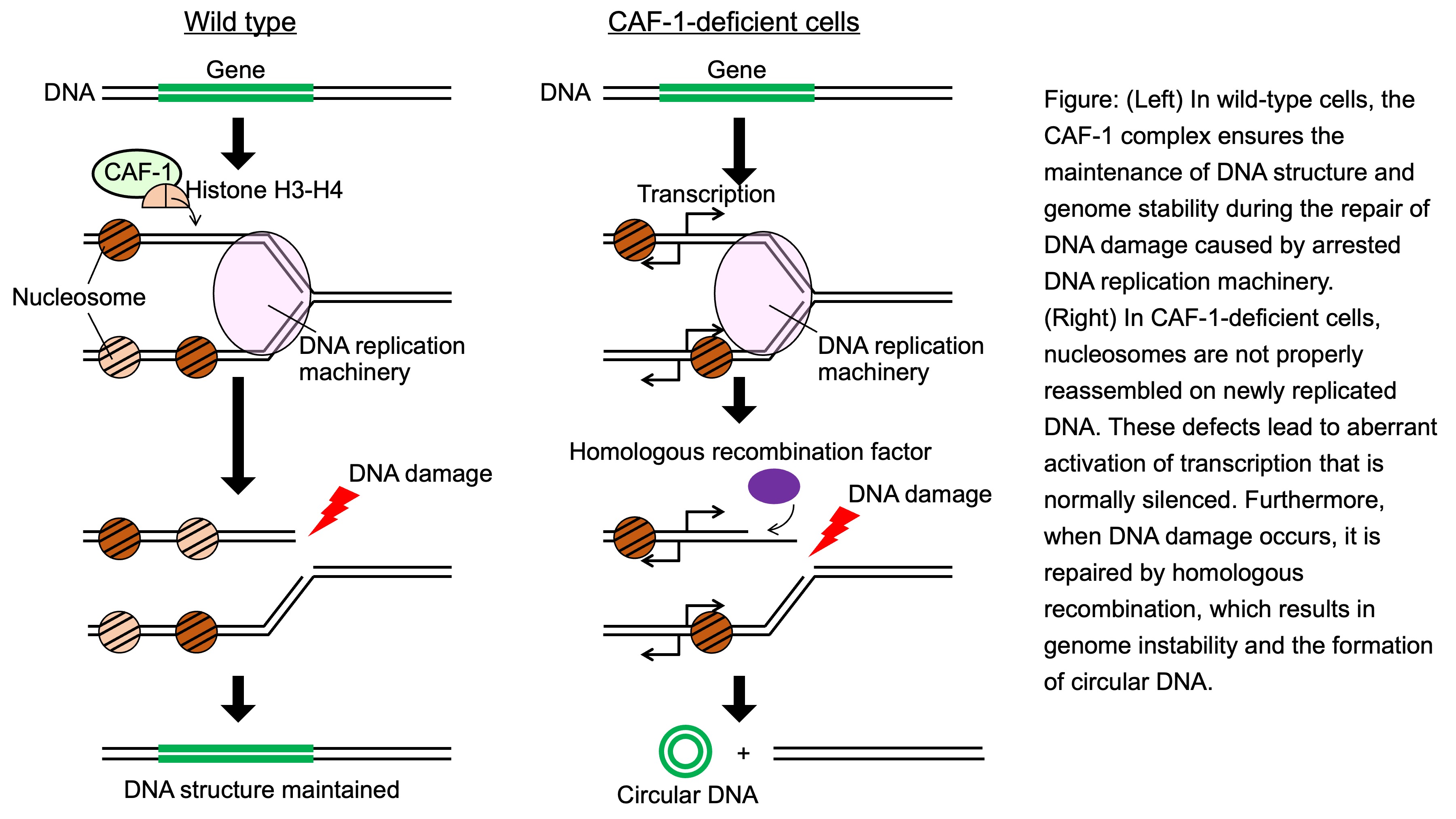
In this study, the research group used the model organism budding yeast and found that when the CAF-1 complex—which reconstructs chromatin after DNA replication—is lost, numerous circular rDNA molecules are generated from the ribosomal DNA (rDNA) region. The researchers discovered that these circular rDNAs are mistakenly produced during the repair process after DNA replication stalls and the DNA becomes fragmented. CAF-1 normally functions to properly assemble nucleosomes at regular intervals on newly replicated DNA.
This study demonstrates that the loss of CAF-1 destabilizes the genome and significantly advances our understanding of how ecDNA might be generated in cancer cells. The findings are expected to contribute to future diagnostic approaches and the development of new therapies.