
Before joining NIG Prof. Yasushi HIROMI spent a total of 13 years outside Japan, first as a postdoctoral fellow (Switzerland and US) and then as a faculty at Princeton University. Upon returning to Japan, he wanted to do something to make use of his experience abroad. He had noticed that the excellence and impact of research done in Japan is often not readily visible in the publications made by Japanese researchers. With this awareness, he started a new educational program at NIG, to help future researchers to be active on a global scale.
 Dr. Hiromi’s laboratory studies mechanisms and principles of neural development: the generation of diverse neurons from neural stem cells, and the construction of neural circuit through axon guidance. They use fruit flies (Drosophila melanogaster) as an experimental organism. “There’re two types of researchers who use fruit flies,” he says, “those who have loved insects since childhood, and those who seek to understand the logics that govern various phenomena.” Strong in physics and mathematics and majoring in physics as an undergraduate, Dr. Hiromi definitely belongs to the second type.
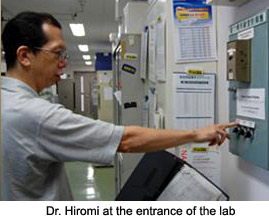 After obtaining his Ph.D., he continued research abroad, first as postdoctoral fellow and then as assistant professor at Princeton University. It was then when he was recruited to NIG as full professor. Dr. Hiromi thinks he may be the NIG’s record holder for the smallest number of publications at the time of appointment as professor. Apparently NIG recognized that his caliber cannot be measured merely by the number of publications.
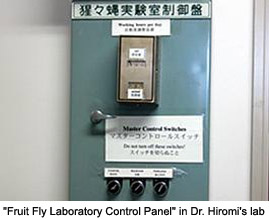
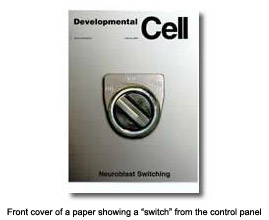 On the wall of Dr. Hiromi’s laboratory is a “Fruit Fly Laboratory Control Panel,” on which three switches —“Creativity”, “Bench work” and “Publication” — are kept “ON” at all times. This playful arrangement is the proof of Dr. Hiromi’s solid commitment to research and education. “There are things you can teach to your students and things you can’t. I don’t think there’s a way one can teach originality.” Originality is a reflection of personality, so he wants to help his students “develop” their originality, rather than trying to teach it. He does this by engaging students into dialogs, and enticing them to think deeply. Likewise, he runs the Developmental Biology course in a similar way, by discussing over original research article, not only to understand the contents, but also to seek new directions and challenges that the results generate. An educational curriculum that caters a large number of students is efficient, but it is more important to create an educational framework that can draw out the best of each student’s potential. At NIG, with an excellent educational and research environment, Dr. Hiromi now stands at the heart of its education program.