Sawa Group • Multicellular Organization Laboratory
Differential functions of multiple Wnts and receptors in cell polarity regulation in C. elegans
Hitoshi Sawa , Masayo Asakawa , Takefumi Negishi
Genetics(2026)DOI:10.1093/genetics/iyag004 DOI:10.1101/2025.11.25.690575
Metazoan species possess multiple Wnt ligands and receptor genes that regulate diverse developmental processes. Because these genes often act redundantly, analysis of single-gene mutants does not necessarily reveal the full roles of Wnt signaling. In C. elegans, three Wnt genes (cwn-1, egl-20, and cwn-2) and three receptor genes (lin-17/Fzd, mom-5/Fzd, and cam-1/Ror) redundantly regulate the polarity of asymmetrically dividing seam cells. Here, we comprehensively analyzed genetic interactions among these Wnt and receptor genes. In mom-5 mutant backgrounds, additional mutations in Wnt genes disrupted cell polarization. In contrast, in cam-1 mutant backgrounds, Wnt mutations frequently caused abnormal polarity orientation. These findings indicate that MOM-5 and CAM-1 play distinct roles in establishing cell polarization and determining its orientation, respectively. lin-17 mutations suppressed polarity reversal in multiple Wnt compound mutants, suggesting that LIN-17 may function as a molecular switch for polarity orientation. Although all three Wnt genes regulate polarity orientation in a gradient-independent manner in the absence of receptor mutations, in lin-17 mutant backgrounds, reversing the expression gradients of cwn-1 and egl-20, but not cwn-2, enhanced polarity reversal. This suggests that cwn-1 and egl-20 act not only permissively but also instructively to regulate polarity orientation. Together, our results reveal distinct and cooperative functions of multiple Wnt ligands and receptors that ensure robust control of cell polarity.
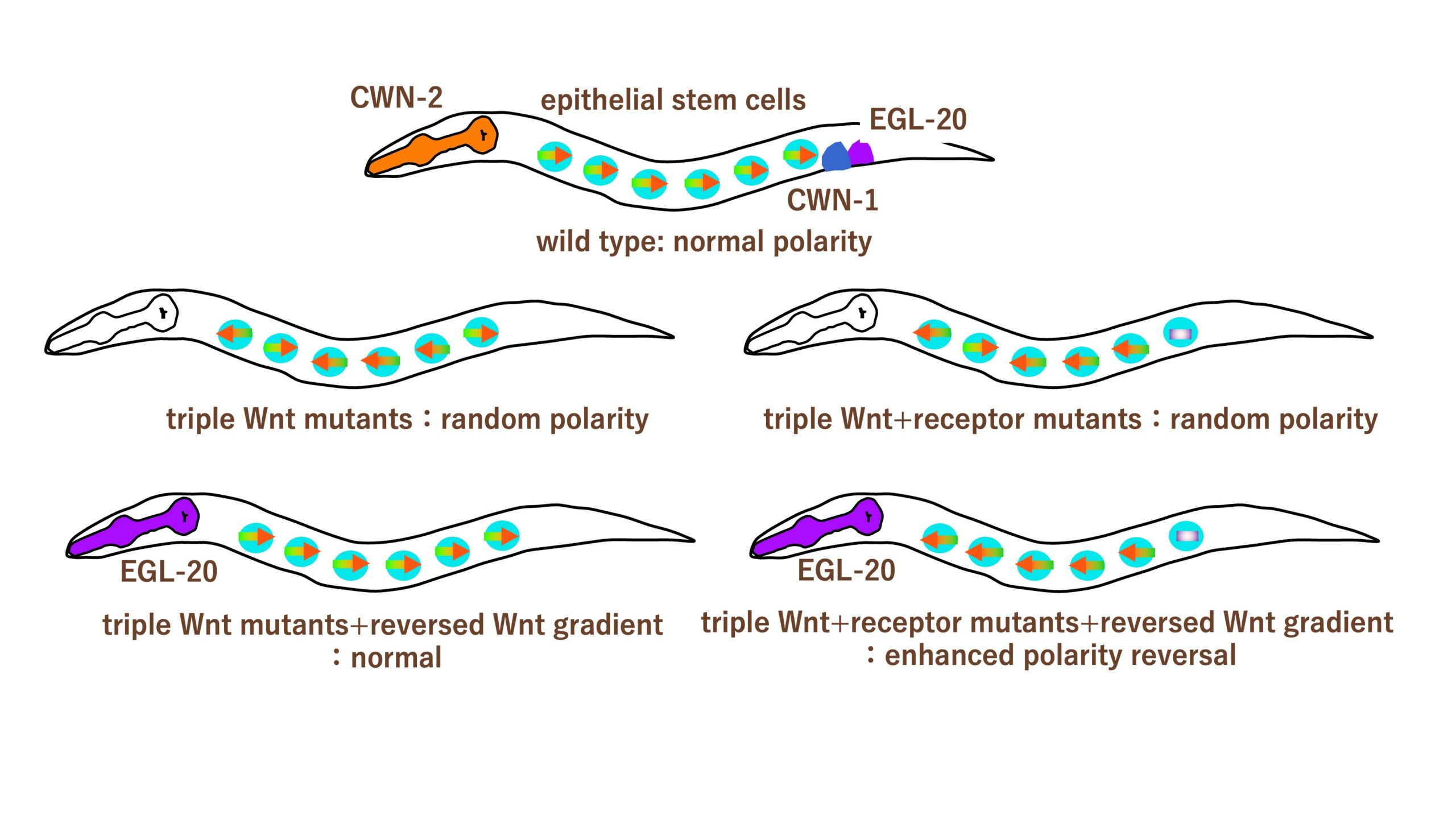
In triple Wnt mutants or triple Wnt+ receptor (lin-17/Frizzled) mutants, polarity of epithelial stem cells are randomized. When Wnt (EGL-20) which is normally expressed posteriorly, is expressed anteriorly reversing the Wnt gradient, polarity defects are rescued in triple Wnt mutants, while it enhances polarity reversal in triple Wnt+ receptor mutants.