Kimura Group • Cell Architecture Laboratory
Active fluctuations of cytoplasmic actomyosin networks facilitate dynein-driven transport
Takayuki Torisawa, Kei Saito, Ken’ya Furuta, Akatsuki Kimura
iScience (2025) Volume 28, Issue 12 114096 DOI:10.1016/j.isci.2025.114096
Inside cells, molecular motors transport cargo through a highly crowded cytoplasmic environment. While such an environment is assumed to hinder transport, its precise effect remains unclear. Here, we investigated how the dynamics of cytoplasmic environments affect dynein-driven transport in C. elegans early embryos. In living embryos, we found that an artificial dynein-cargo complex exhibited significantly faster transport than in vitro, indicating an active acceleration mechanism in vivo. By altering the activity of actomyosin networks, we found that dynein-driven transport was accelerated by actomyosin-driven cytoplasmic fluctuations, with speed increasing upon myosin upregulation and decreasing upon its depletion. Furthermore, in vitro force measurements of dynein suggest that the asymmetric force response to random forces, generated by fluctuating dynamics of actomyosin networks, may contribute to acceleration. This study provides insights into a regulatory mechanism of molecular motors within fluctuating cytoplasm, harnessing cytoplasmic fluctuations to enhance transport efficiency in a highly crowded environment.
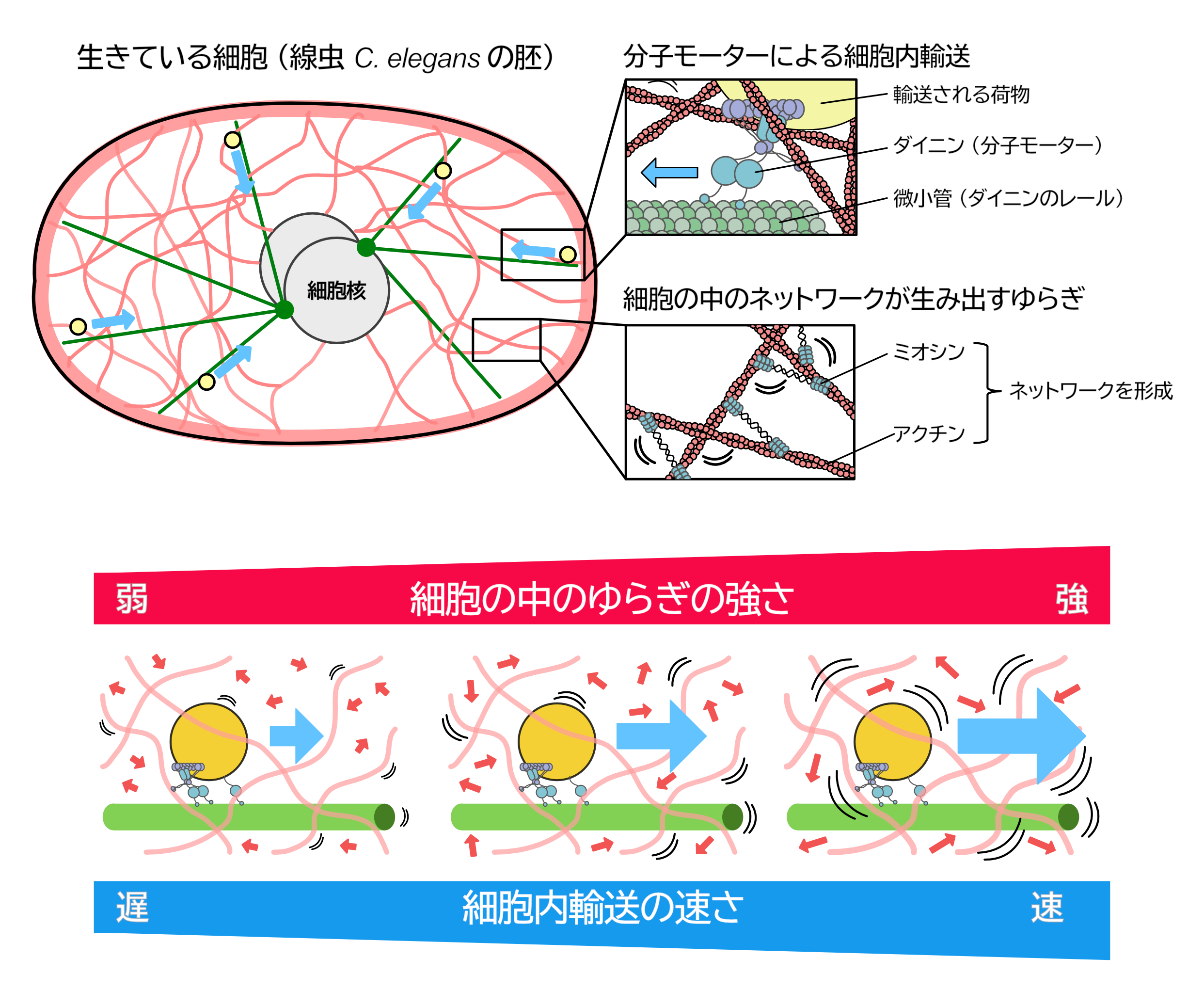
Figure: Model summarizing the biphasic change in local chromatin dynamics during doxycycline-induced transformation of EMR cells. The blue curve denotes a transient rise in local chromatin mobility after induction (orange arrow) followed by a return to baseline (green arrow). The increase coincides with elevated active histone marks (H3/ H4 acetylation) and transcription; dynamics subsequently restabilize while oncogene expression and tumor growth persist. Metabolic reprogramming may contribute to this process.