Press release
Decoupling of visual feature selectivity in the retinocollicular pathway
Ole S. Schwartz, Akihiro Matsumoto, Haruka Yamamoto, and Keisuke Yonehara
Current Biology 2025 DOI:10.1016/j.cub.2025.11.050
 Press release (In Japanese only)
The retina is composed of discrete functional cell types that are also characterized by distinct morphology and gene expression. It remains, however, unclear whether similar discrete functional cell types exist in the visual regions downstream of the retina. Here we used two-photon calcium imaging to investigate the response space structure in the retina and in the superficial layers of the mouse superior colliculus (SC), a major retinorecipient area. We found that while retinal ganglion cells showed a clear dependence between responses to luminance and motion, responses to the two stimuli exhibited weaker couplings in collicular neurons. Because of this decoupling, functional clustering based on responses to both luminance and motion had significantly reduced separability compared to clustering based on responses to either. Our work suggests that the SC is not simply a relay station for retinal inputs, but rather generates novel feature selectivity that diversifies cellular responses, perhaps through nonlinear neural processes involving the decoupling and recoupling of retinal ganglion cell’s feature selectivity.
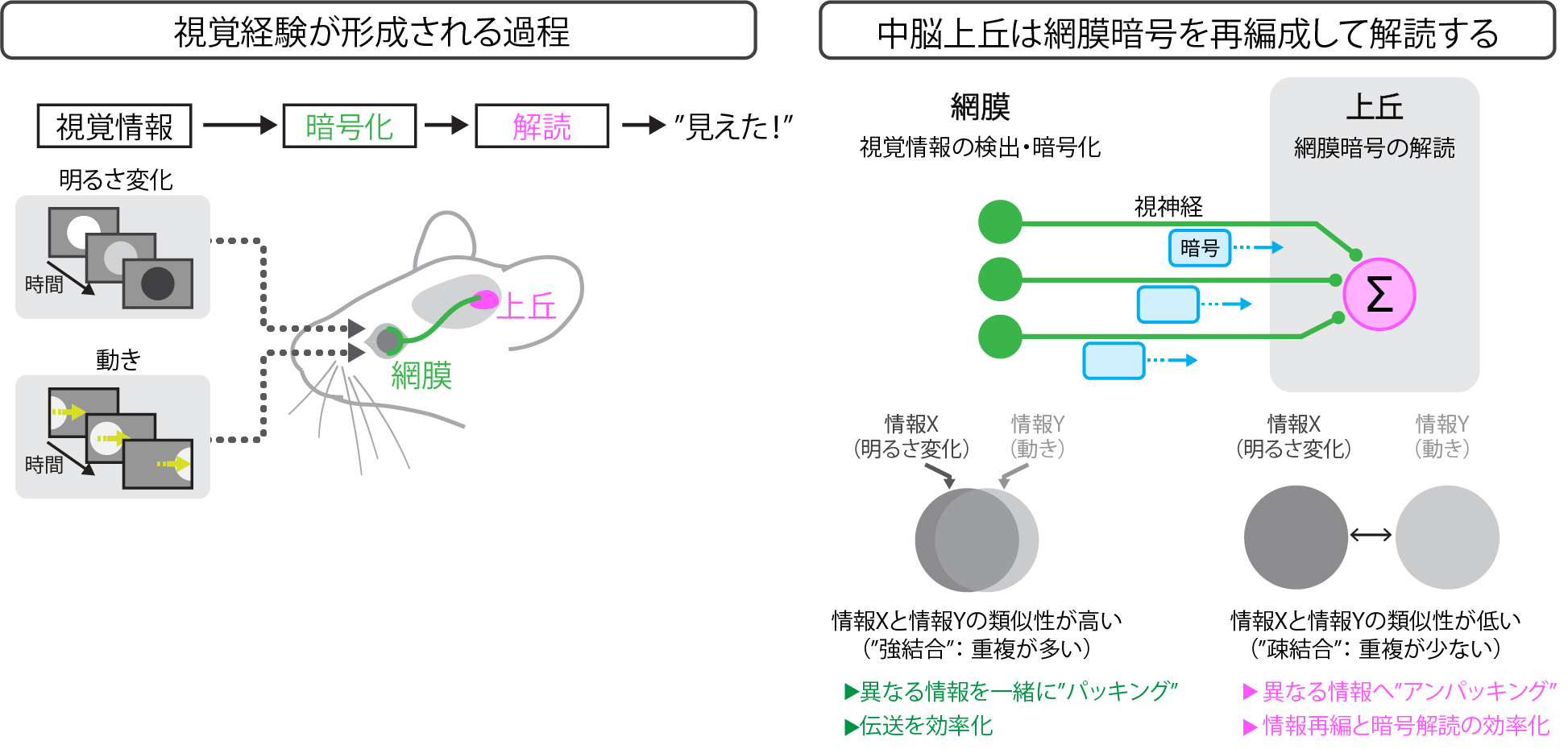
(Left) The visual information processing pathway. Visual information is detected and encoded in the retina and then transmitted to the superior colliculus.
(Right) In the retina, the mutual information between neural activities representing two types of visual information—brightness change (information X) and image motion (information Y)—is high. In the superior colliculus, the redundancy present in the retinal code is decoupled.