Miyagishima Group / Symbiosis and Cell Evolution Laboratory
The closed nutrient recycling system in the Paramecium–Chlorella photosymbiosis contributes to survival under oligotrophic conditions
Kaoru Okada, Takayuki Fujiwara, Shunsuke Hirooka, Yusuke Kobayashi, Ryo Onuma, and Shin-ya Miyagishima
Science Advances 11, eadz0004 (2025) DOI:10.1126/sciadv.adz0004
Endosymbiotic relationships between a heterotrophic host and a unicellular algal endosymbiont are observed across many eukaryotic lineages. Although these relationships are prevalent in oligotrophic environments, how they function and provide an advantage under such conditions remains largely unknown. To address these issues, we examined the behaviour of the ciliate Paramecium bursaria hosting Chlorella endosymbionts under nitrogen- and prey-depleted conditions. The Paramecium host survived for up to five weeks while maintaining the number of Chlorella endosymbionts, whereas aposymbiotic Paramecium and free-living Chlorella either died or bleached, respectively, under the same conditions. In the symbiotic state, the host continuously fed on the endosymbionts without excreting nitrogenous waste into the medium, while the remaining endosymbionts continued to proliferate using heterotrophic metabolites from the host and light energy. Thus, the cyclical farming of endosymbionts by the host maintains a high concentration of nutrients within the closed system, providing a selective advantage in oligotrophic environments.
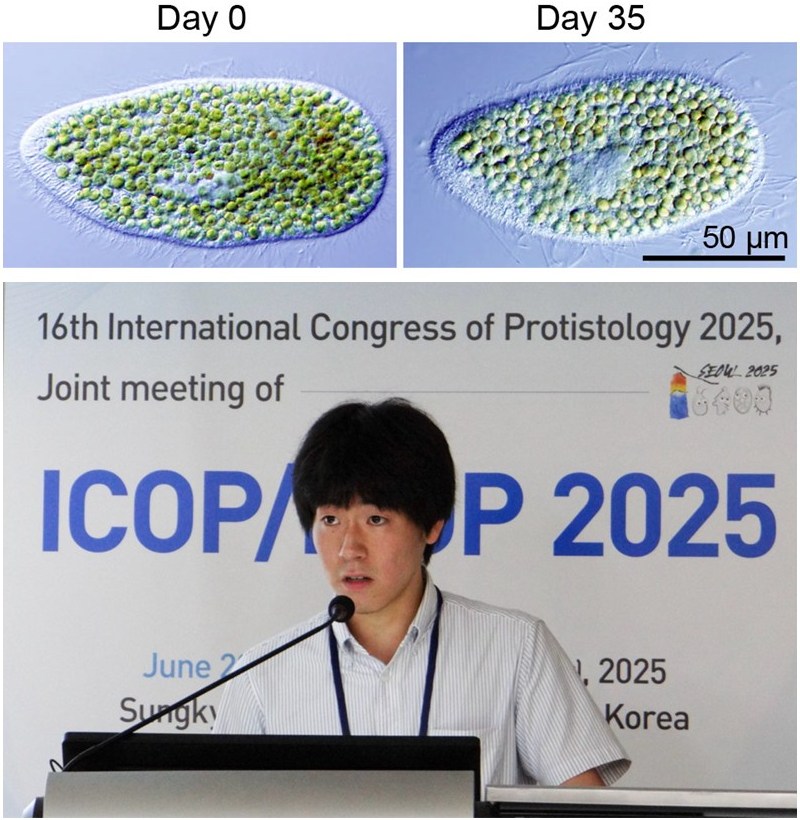
Figure. Micrographs of Paramecium bursaria and Okada-san (a graduate student) presenting the findings at an international conference
A Paramecium bursaria cell (Day 0) that had been grown with bacterial prey was further incubated for 35 days under light in a culture medium lacking prey as well as nitrogen and phosphorus sources (Day 35). The host paramecium remained viable while maintaining approximately 300 endosymbiotic Chlorella cells per host cell. These Chlorella cells were partly digested by the host but also proliferated, resulting in the apparent number of symbionts being largely maintained. Okada-san presented these findings at ICOP/ISOP 2025, an international protozoology conference held in Seoul, Korea, from June 22 to 27, 2025, and received the Best Oral Presentation Award