
Genome Diversity Laboratory
Mori Group
Genome biology to understand the organismal diversity in environments
Faculty

Research Summary
Organisms harbor highly diverse genomes and have adapted to a wide range of environments. In our laboratory, we employ computational approaches such as comparative genomics and metagenomics to investigate the evolutionary and ecological processes underlying these adaptations. Our research includes reconstructing genome sequences from ancient DNA of extinct animals to infer phylogenetic relationships, assembling high-quality genomes of novel microbes from metagenomic data and constructing genome databases of these uncultured organisms, and elucidating host–microbe symbiotic interactions through metagenomic analyses. In parallel, we develop advanced bioinformatics methods and analytical tools to further enhance these studies. Through close collaboration with the Advanced Genomics Division, we actively engage in numerous national and international research collaborations, leveraging our computational innovations to drive cutting-edge genomic research.

a database of metagenome-assembled genomes. Microbial genomes can
be queried based on taxonomy, environmental habitat, and predicted
phenotypic traits.

AutoFixMark, a tool for predicting seven CO₂ fixation pathways in
chemolithoautotrophic microbes from genome sequences. The dataset
comprises 347 genome-sequenced microbes for which the functionality of
CO₂ fixation pathways has been experimentally validated.
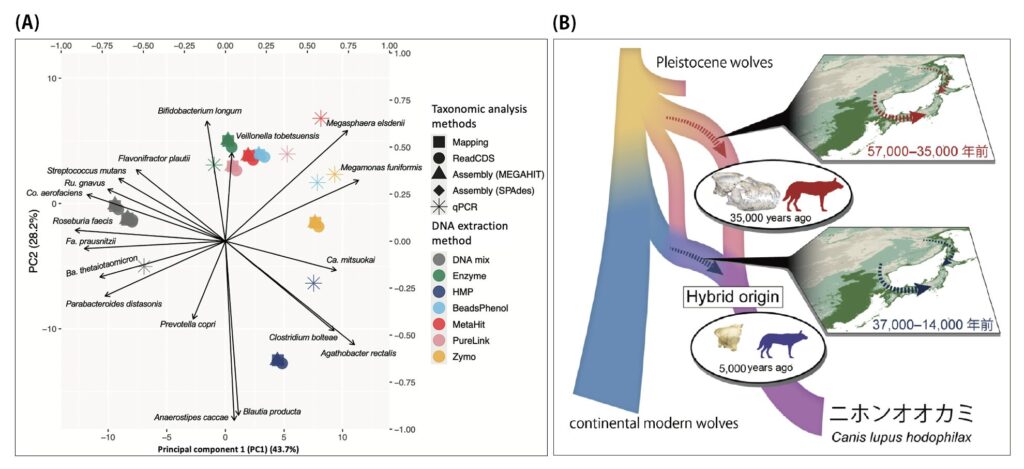
(B) The inferred history of the origin of the Japanese wolf. Our ancient DNA study of Pleistocene wolf remains recovered in Japan reveals that the origin of Japanese wolf is a hybrid of two morphologically distinct wolf lineages.
Selected Publications
- Mori H, Kato T, Ozawa H, Sakamoto M, Murakami T, Taylor TD, Toyoda A, Ohkuma M, Kurokawa K, Ohno H. Assessment of metagenomic workflows using a newly constructed human gut microbiome mock community. DNA Res. 2023;30(3):dsad010.
- Segawa T, Yonezawa T, Mori H, Akiyoshi A, Larramendi A, Kohno N. Ancient DNA from Palaeoloxodon naumanni in Japan reveals early evolution of Eurasian Palaeoloxodon. iScience. 2025;28(12):114156.
- Kim J, Murakami T, Toyoda A, Mori H. Behavioural phase transitions in the migratory locust, Locusta migratoria, are related to changes in the gut bacterial composition. ISME Commun. 2026;6(1):ycag009.
- Kawashima S, Okabeppu Y, Miyazawa S, Ichikawa N, Nagazumi H, Nishihara Y, Nakazato T, Goto S, Kurokawa K, Ishii M, Mori H. A curated resource of chemolithoautotrophic genomes and marker genes for CO₂ fixation pathway prediction. Sci Data. 2026;13(1):121.
- Mori H, Fujisawa T, Higashi K, Tanizawa Y, Nakagawa Z, Nishide H, Fujiyoshi M, Nakamura Y, Uchiyama I, Matsui M, Yamada T. Microbiome Datahub: an open-access platform integrating environmental metadata, taxonomy, and functional annotation for comprehensive metagenome-assembled genome datasets. Microbiome. 2026;14(1):119.