
Molecular Life History Laboratory
Kuraku Group
Decoding evolution through the mechanism of genomic readout
Faculty


Research Summary
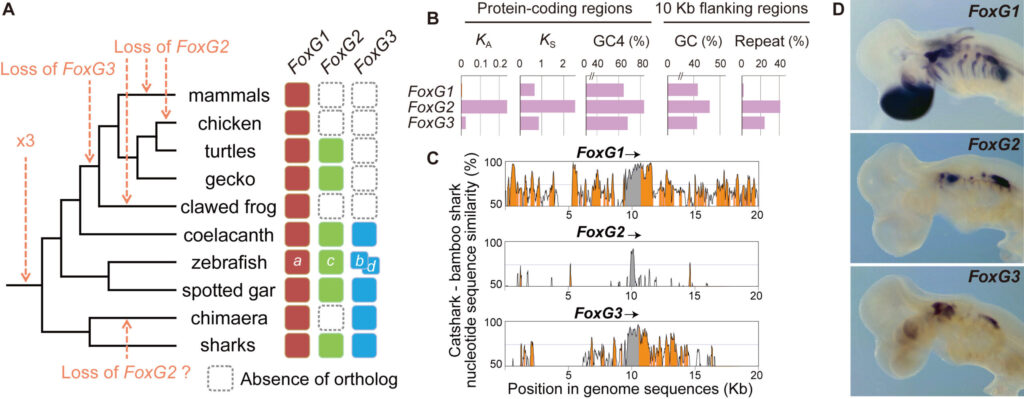
Our group aims to infer the molecular-level history of com-plex life, based on molecular phylogenetic approaches to evo-lutionarily dissecting biodiversity with increasing knowledge of cellular events from genome-wide profiling. We mainly focus on vertebrates including elusive wildlife with unique phenotypes. Our interests are categorized into these themes.
- Deciphering the evolutionary history of genomes
- Formulating genome evolution by referring to cellular events
- Advancing genome-wide data acquisition and analysis methods
Selected Publications
- Kawaguchi YW, Matsumoto R, Kuraku S, Improved genome assembly of whale shark, the world’s biggest fish: revealing intragenomic heterogeneity in molecular evolution, GigaScience, 2026, giag014,
https://doi.org/10.1093/gigascience/giag014 - Kuraku S. Vertebrate Hox clusters as transposon repellents against the genomic accordion model, Zool. Sci. 43: 35-43.
https://doi.org/10.2108/zs250058 - Niwa T, Uno Y, Ohishi Y, Kadota M, Aburatani N, Kiyatake I, Katooka D, Yorozu M, Tsuzuki N, Toyoda A, Takagi W, Nakamura M, Kuraku S. Sharks and rays have the oldest vertebrate sex chromosome with unique sex determination mechanisms, Proc. Natl. Acad. Sci. U.S.A. 2025, 122:e251367612
https://doi.org/10.1073/pnas.2513676122 - Hara Y, Kuraku S. Intragenomic mutational heterogeneity: structural and functional insights from gene evolution. Trends Genet. 2025, May; 5:S0168-9525(25)00075-7.
https://doi.org/10.1016/j.tig.2025.03.007