
Neurobiology and Pathology Laboratory Asakawa Group
An orthogonal Cro/OR3 system reveals an influence of astrocytes on motor neuron positioning
Haruna Nakajo *, Kimiko Saka *, Yukiko Yoshida, Saki Ymaura, Naoko Mouri, Shoko Kawamoto, Kazuhide Asakawa. *: these authors contributed equally.
iScience DOI:10.1016/j.isci.2026.117967
Press Release
Multiplex and orthogonal control of gene expression is increasingly required to experimentally dissect how multicellular biological systems are organized and function. In this study, we developed a phage-derived Cro/OR3 system for cell-type-specific control of gene expression that functions robustly in zebrafish and human cells. A Cro repressor fused to the VP16 activation domain efficiently drives expression of OR3 operator-linked genes, and its activity can be targeted to specific cell populations using enhancer/promoter-controlled zebrafish lines. As a proof of concept, we perturb glutamate transporter Slc1a3b-expressing cells by Cro/OR3-mediated expression of a human ataxia-associated, uptake-deficient Slc1a3b variant, resulting in impaired astrocyte development and central canal malformation, accompanied by uncoordinated locomotion. Concurrent Gal4/UAS-mediated visualization of spinal motor neurons reveals markedly disrupted positioning of motor neurons, suggesting that astrocyte-mediated glutamate homeostasis contributes to their proper positioning during spinal circuit assembly. Together, these results establish the Cro/OR3 system as an orthogonal platform for targeted gene expression, enabling mechanistic dissection of multicellular systems.
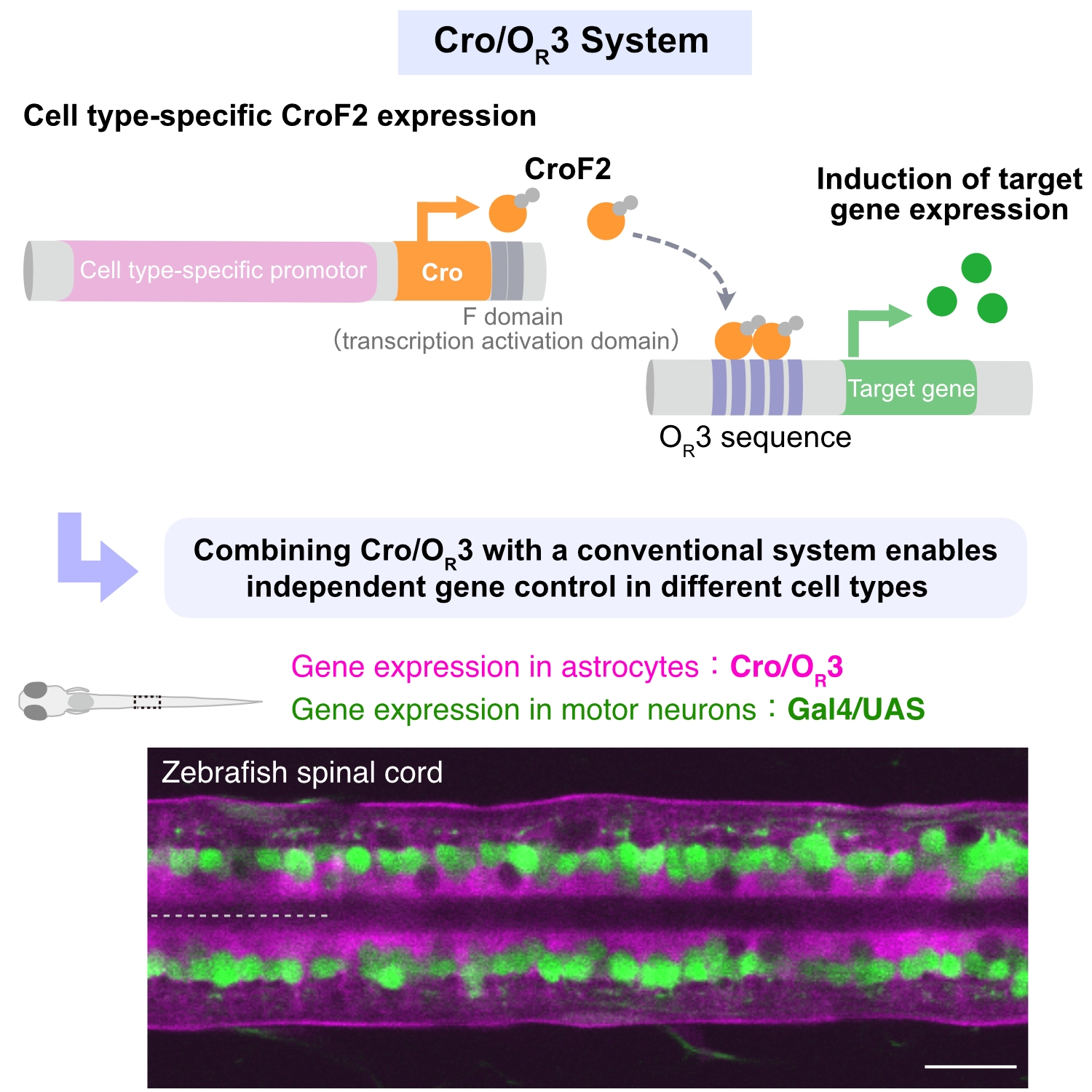
A newly developed binary gene expression system Cro/OR3.