
Yamamichi Group • Theoretical Ecology and Evolution Laboratory
The double-edged effect of environmental fluctuations on evolutionary
Shota Shibasaki and Masato Yamamichi
Evolution(2026) DOI:10.1093/evolut/qpag034
(This paper was selected as an Editor’s Choice article in the June issue of Evolution.)
Human activities are exposing organisms to rapid environmental deterioration, such as rising temperatures and increasing salinity in freshwater habitats. Species can sometimes avoid extinction by evolving rapidly, a process known as evolutionary rescue. While previous studies have mainly examined steadily changing environments, real-world environments also vary in the magnitude of fluctuations. To investigate how such fluctuations during environmental deterioration affect evolution, we conducted a 12‑week experiment using the freshwater alga Chlorella vulgaris under rising salinity with no, small, or large fluctuations. Populations exposed to large fluctuations grew the slowest at the final experimental salinity but exhibited the fastest growth when subsequently exposed to even higher salinity. Mathematical modeling revealed the same trend, indicating that environmental fluctuations can both impede and promote evolutionary rescue. These findings highlight the dual impact of environmental fluctuations and suggest that conservation strategies must carefully consider how fluctuating environments shape evolutionary responses.
This study was supported by the Center for Frontier Research, National Institute of Genetics; JSPS KAKENHI (Grant Numbers JP19K16223, JP20KK0169, JP21H02560, JP22H02688, and JP22H04983); JST CREST (Grant Number JPMJCR23N5); the Inamori Foundation; and the Australian Research Council Discovery Project (Grant Number DP220102040).
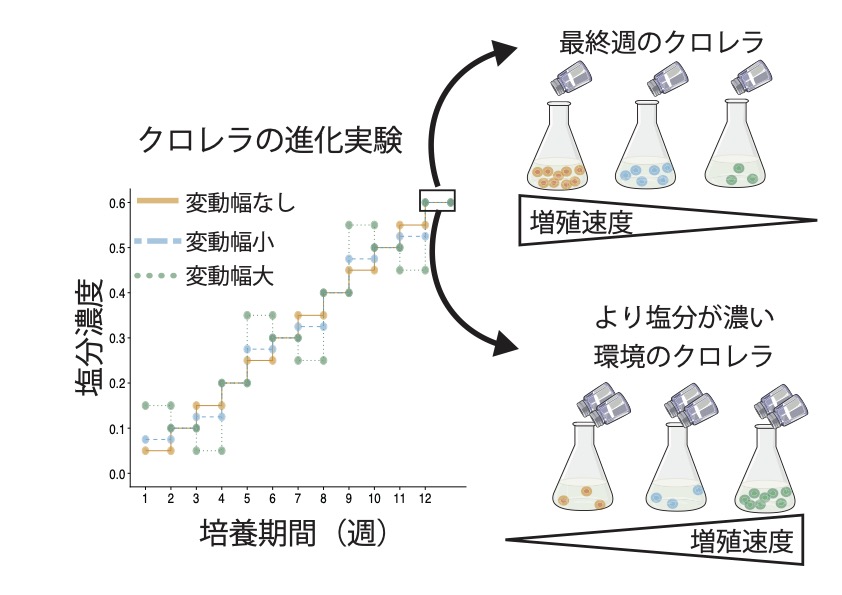
Left: A 12-week culture of green algae under a constant increase (orange), or with small (blue) or large (green) fluctuations in salt concentration. Right: While environmental fluctuations impeded adaptation to salinity by the end of the experiment, they facilitated growth under a higher salt concentration.
Image credits: The flask illustrations were obtained from TOGO Picture Gallery (https://doi.org/10.7875/togopic.2011.9), and the salt shaker illustration was obtained from Servier Medical Art (https://smart.servier.com/smart_image/salt-shaker/). Both images are used under the terms of the Creative Commons Attribution 4.0 International License (CC BY 4.0).