
Multicellular Organization Laboratory
Sawa Group
Generation of cellular diversity by asymmetric cell division
Faculty


Research Summary
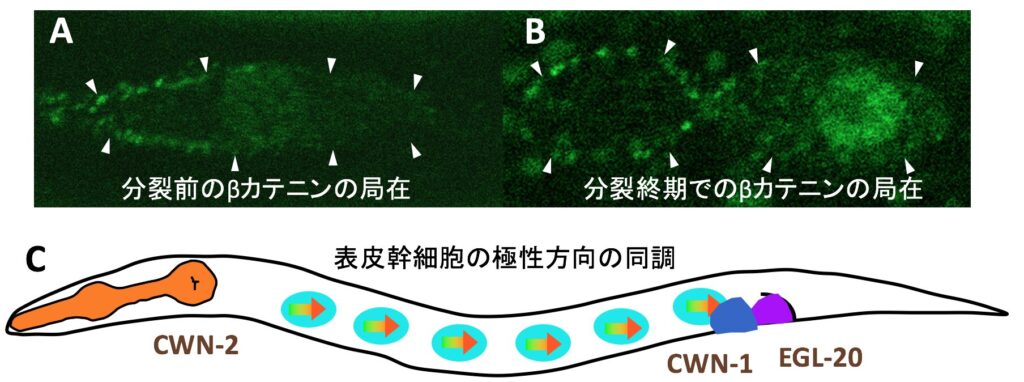
Various cells including stem cells undergo asymmetric cell divisions to produce daughter cells with distinct cell fates. Most cells in C. elegans have the same anterior-posterior polarity in terms of localizations of Wnt signaling components such as β-catenin, and divide asymmetrically to produce a variety of cell types. Similar asymmetric localization was reported in mouse ES cells. We are studying how each cell knows the correct orientation, how it divides asymmetrically and how the daughter cells acquire specific cell fates.
Selected Publications
- So S, Asakawa M, Sawa H. Distinct functions of three Wnt proteins control mirror-symmetric organogenesis in the C. elegans gonad. Elife. 2024 Nov 1;13:e103035.
- Negishi T, Kitagawa S, Horii N, Tanaka Y, Haruta N, Sugimoto A, Sawa H, Hayashi KI, Harata M, Kanemaki MT. The auxin-inducible degron 2 (AID2) system enables controlled protein knockdown during embryogenesis and development in Caenorhabditis elegans. Genetics. 2022 Feb 4;220(2):iyab218.
- Sugioka K, Fielmich LE, Mizumoto K, Bowerman B, van den Heuvel S, Kimura A, Sawa H. Tumor suppressor APC is an attenuator of spindle-pulling forces during C. elegans asymmetric cell division. Proc Natl Acad Sci U S A. 2018 Jan 30;115(5):E954-E963.