
Gene Quantity Biology Laboratory
Sasaki Group
Molecular mechanisms and functions of extrachromosomal circular DNAs in eukaryotes
Faculty

Research Summary
In cancer cells, chromosomal regions containing oncogenes and drug resistance genes are circularized outside of the chromosome. These circular DNA, referred to as extrachromosomal DNA (ecDNA), accumulates in cells, leading to overexpression of these genes, conferring a proliferative advantage, and thereby contributing to cancer onset, progression, and therapy resistance. However, the molecular mechanisms that govern the generation and maintenance of ecDNA, and how circularization of chromosomal regions alters the physiological activity of the DNA, remain poorly understood. In addition, various types of small circular DNAs have been observed in normal human cells, but their functions are not well characterized. Our laboratory aims to elucidate the biogenesis and functions of diverse circular DNA species using a combination of complementary experimental and computational approaches.
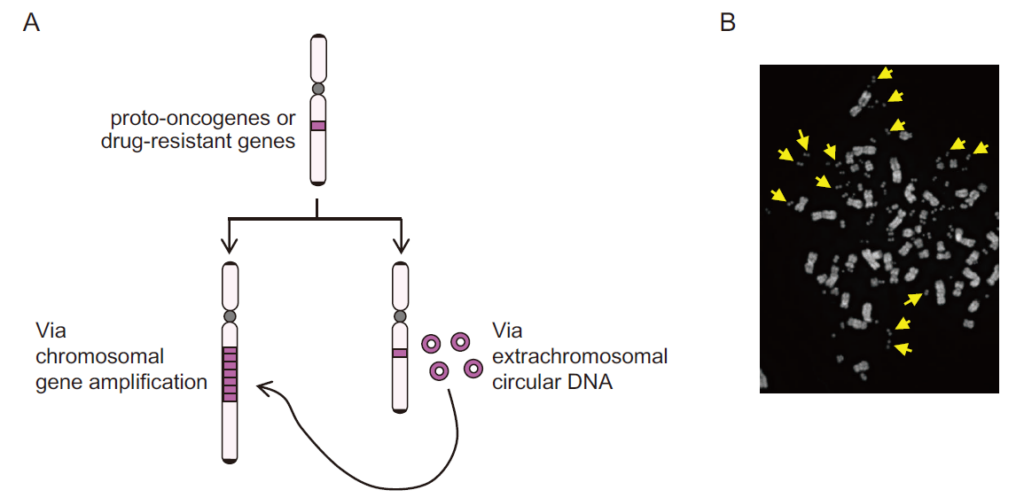
(B) A colon adenocarcinoma cell line, COLO 320DM, accumulates extrachromosomal circular DNAs (arrows) that contain a proto-oncogene, c myc.
Selected Publications
- Sasaki M, Kobayashi T. Transcription near arrested DNA replication forks triggers ribosomal DNA copy number changes. Nucleic Acids Research 2025 Nov 27; 53(22) gkaf1010
- Sasaki M, Kobayashi T. Ctf4 Prevents Genome rearrangements by suppressing DNA double-strand break formation and its end resection at arrested replication forks. Mol Cell. 2017 May 18;66(4):533-545.e5.
- Sasaki M, Kobayashi T. Regulatory processes that maintain or alter ribosomal DNA stability during the repair of programmed DNA double-strand breaks. Genes & Genetic Systems 2023 Sep 30;98(3):103-119