
Molecular Cell Engineering Laboratory
Kanemaki Group
Studying DNA replication by use of an original degron-based technology
Faculty


Research Summary
Our laboratory pioneered to develop the auxin-inducible degron (AID) technology, by which degron-fused proteins of interest can be rapidly degraded by the addition of a plant hormone, auxin. We recently improved it and established AID2 to control the degradation of proteins of interest not only in yeast and mammalian cell lines, but also in mice. We are currently trying to develop related genetic technologies and, by employing AID2, to understand the mechanisms of DNA replication in human cells and mice.
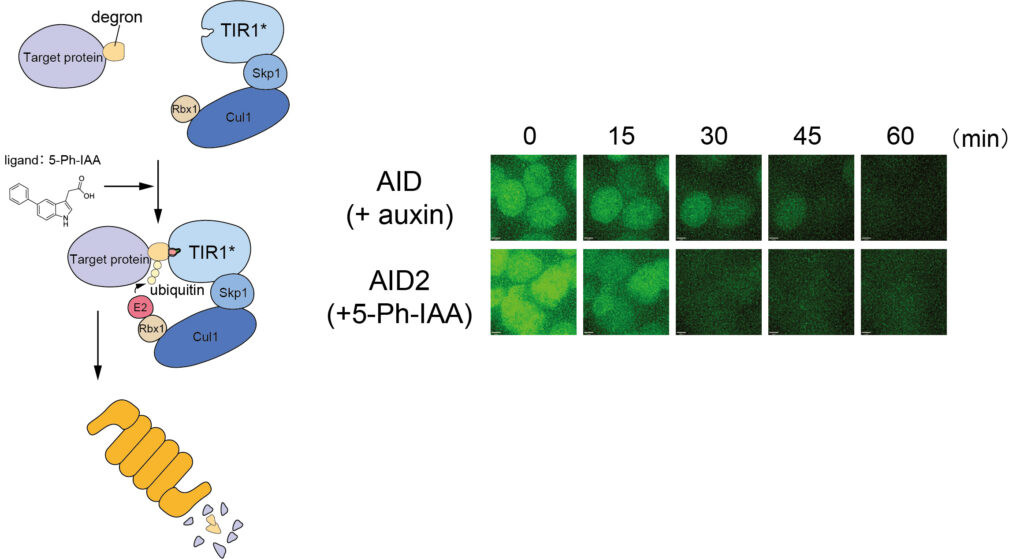
(Right) Comparison of AID and AID2. A cohesin subunit RAD21 was induced for depletion. AID2 enabled even faster depletion.
Selected Publications
- Hatoyama Y, Islam M, Bond AG, Hayashi KI, Ciulli A, Kanemaki MT. Combination of AID2 and BromoTag expands the utility of degron-based protein knockdowns. EMBO Rep. 2024 Sep;25(9):4062-4077.
- Zhu X, Kanemaki MT. Replication initiation sites and zones in the mammalian genome: Where are they located and how are they defined? DNA Repair (Amst). 2024 Sep;141:103713.
- Saito Y, Santosa V, Ishiguro KI, Kanemaki MT. MCMBP promotes the assembly of the MCM2-7 hetero-hexamer to ensure robust DNA replication in human cells. Elife. 2022 Apr 19;11:e77393.
- Yesbolatova A, Saito Y, Kitamoto N, Makino-Itou H, Ajima R, Nakano R, Nakaoka H, Fukui K, Gamo K, Tominari Y, Takeuchi H, Saga Y, Hayashi KI, Kanemaki MT. The auxin-inducible degron 2 technology provides sharp degradation control in yeast, mammalian cells, and mice. Nat Commun. 2020 Nov 11;11(1):5701.