
Neurobiology and Pathology Laboratory
Asakawa Group
Mechanisms of neural circuits underlying motor control across development, homeostasis, aging, and disease
Faculty


Research Summary
We aim to understand how neural circuits that generate movement develop and mature, and to use this knowledge to protect motor circuits from aging and disease. Using zebrafish as a primary model, we study motor circuits in vivo across behavioral, circuit, cellular, and molecular levels. We focus on protein phase transitions, RNA metabolism, synapses, extracellular matrix, and glial cells to uncover the mechanisms underlying the selective vulnerability of motor neurons in amyotrophic lateral sclerosis (ALS).
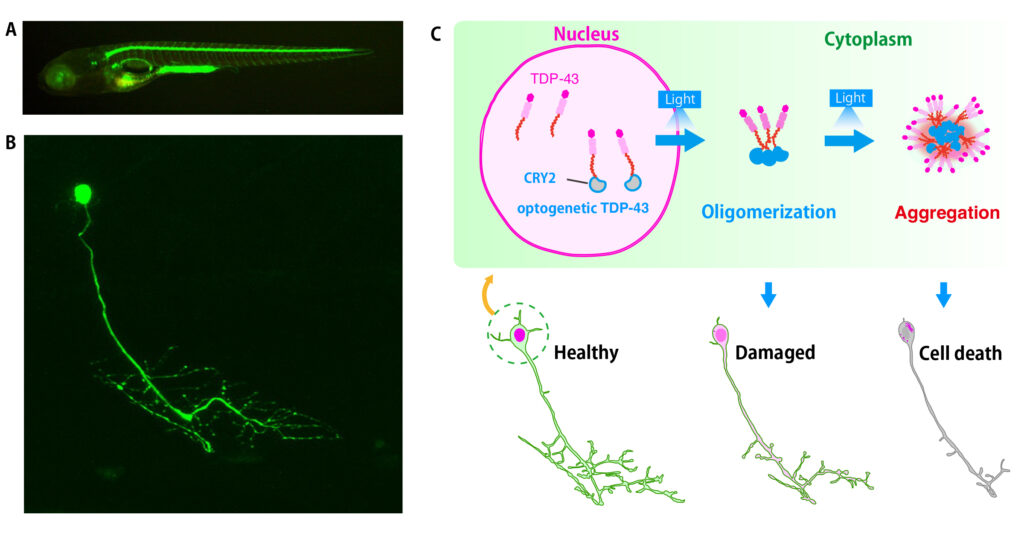
B. Live imaging of a single spinal motor neuron.
C. Optogenetic ALS model. Light-dependent oligomerization of TDP-43 recapitulates ALS-related pathologies in the motor neuron of zebrafish.
Selected Publications
- Asakawa K, Tomita T, Shioya S, Handa H, Saeki Y, Kawakami K. Intrinsically accelerated cellular degradation is amplified by TDP-43 loss in ALS-vulnerable motor neurons in a zebrafish model. Nat Commun. 2025 Oct 27;16(1):9213.
- Asakawa K, Handa H, Kawakami K. Multi-phaseted problems of TDP-43 in selective neuronal vulnerability in ALS. Cell Mol Life Sci. 2021 May;78(10):4453-4465.
- Asakawa K, Handa H, Kawakami K. Optogenetic modulation of TDP-43 oligomerization accelerates ALS-related pathologies in the spinal motor neurons. Nat Commun. 2020 Feb 21;11(1):1004.