
Kitano Group • Ecological Genetics Laboratory
Genome-wide analysis successfully resolves population structure shaped by recent divergence in the endangered bagrid
catfish Pseudobagrus ichikawai
Keisuke Onuki, Ryoichi Tabata, Tappei Mishina, Mutsumi Nishida, and Katsutoshi Watanabe
Ecology and Evolution(2026)DOI:10.1002/ece3.73263
 Press release (In Japanese only)
Recent advancements in genomic sequencing have revolutionized our understanding of biodiversity and its conservation.This study focused on the Nekogigi (Pseudobagrus ichikawai), an endangered freshwater catfish endemic to the Ise and Mikawa Bay regions in central Japan. Despite the speciesʼ critical status, its population history remained elusive due to low genetic diversity.
Using high-resolution genomic analysis, the research team revealed that current Nekogigi populations originated from a single ancestral population during the Last Glacial Period. Population differentiation began around the mid-Last Glacial Period and continued into the post-glacial sea-level rise several thousand years ago. Interestingly, populations on the opposite sides of the bay mouth are genetically more similar than those in the geographically closer inner bay area. This pattern reflects a large-scale, integrated paleo-river system that linked these rivers during the Last Glacial Period, when the bay was dry land.These findings highlight how ancient geological shifts shape modern biodiversity and provide a crucial scientific foundation for the conservation of this unique species and its historical lineages.
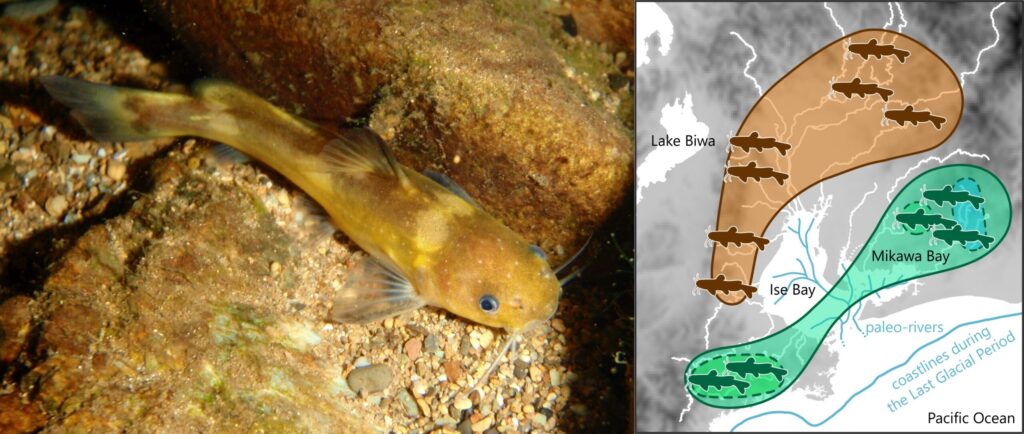
The Nekogigi bagrid catfish (photo by Katsutoshi Watanabe) and the estimated genetic relationships between its local populations. White lines represent current rivers, while blue lines indicate the paleo-rivers and coastlines during the Last Glacial Period.